Sunday

Austen's Great Debates

Debates, not arguments

"It is a truth universally acknowledged ..." Jane Austen's stories make her readers marvel at her power of spinning a tale. We admire her ability to create an intriguing twist of circumstances out of which we wonder, will love triumph? Her storytelling is so good, I still feel this way each time I reread her books. And, of course, there is her eye for human comedy, or absurdities, without being over the top. One thing that can be said about her charactersthey are all believable, and that only makes the humor all the more priceless. I should also mention how she always manages to give the heroine a most interesting flaw that makes the character more acceptable as well as someone we can relate to.

However, Miss Austen had a knack for something else that I have always found impressive, and that is great debates. I call them debates rather than arguments because these well-crafted conversations are between persons expressing their points of view in a calm and rational manner. She had some good arguments, to be sure, such as when Darcy first proposes and we see Lizzy and Darcy really arguing, not debating. Another famous argument is between Emma and Knightley when she talked Harriet into not accepting the farmer Robert Martin's offer of marriage. In each of these two arguments, we are drawn in, feeling the tension from both sides and we can understand why the two involved would be so irritated.

But Austen's debates take us to another place altogether ... that place where emotions don't cloud our judgement and we can stand on the side, considering the impact of what is being discussed. There is no question that the potential is there for feelings to get riled up, but they are presented in that gentle English way that has all the hallmarks of civility.

Here are some of my favorites:


Bingley.jpg

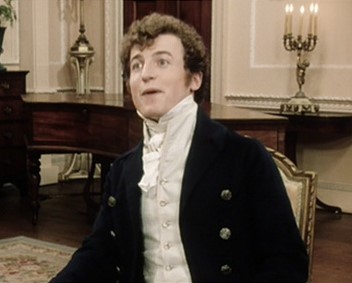
In Pride & Prejudice there is a debate between Lizzy and Darcy about Bingley saying he would leave Netherfield in an instant. Darcy says Charles would just as quickly decide to stay if asked not to leave, and thus begins a wonderful debate between Lizzy and Darcy. And what a debate it is, especially considering the subject! But the two put their hearts into it as each presents sound, compelling points and counterpoints.

In Emma, John Knightley and Jane Fairfax have a debate on, of all things, going to the post office! Again we see JA’s genius in creating a very compelling and heartfelt moment on a subject that on the surface would have little emotional value, but not in the hands of Jane Austen. Talking about Emma, I should also mention the debate between George Knightley and Mrs. Weston about Emma taking Harriet under her wing. Then there are the talks about Frank Churchill between Emma and Knightley that are more good debates.

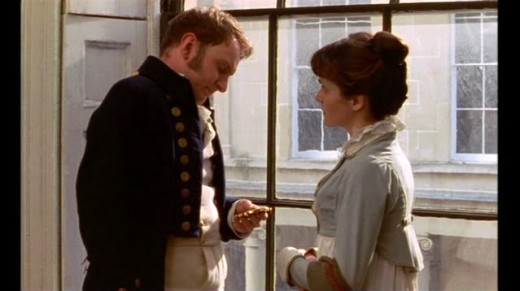
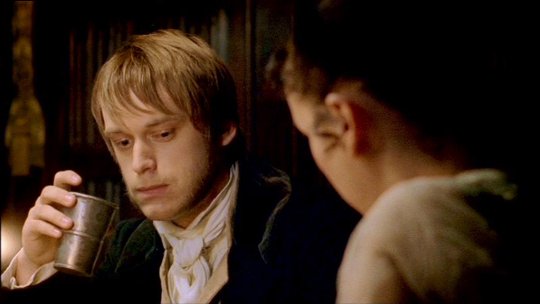
Now, my all-time favorite debate is found in the book Persuasion, though. It is between Anne Elliot and Captain Harville on the subject of whether men or women are the more steadfast in love. The subject is most compelling and profound, and yet these two gentle people discuss this with the utmost respect, and that very English thing I call reserved passion.
5973365_f520.jpg

7413434._SX540_.jpg

I have often wondered if men and women of today would make such claims for their sex? Or are people today both so prepared to dispense with the person they are with when someone they consider more interesting comes along? With so much of that sort of thing going on, I really do wonder.

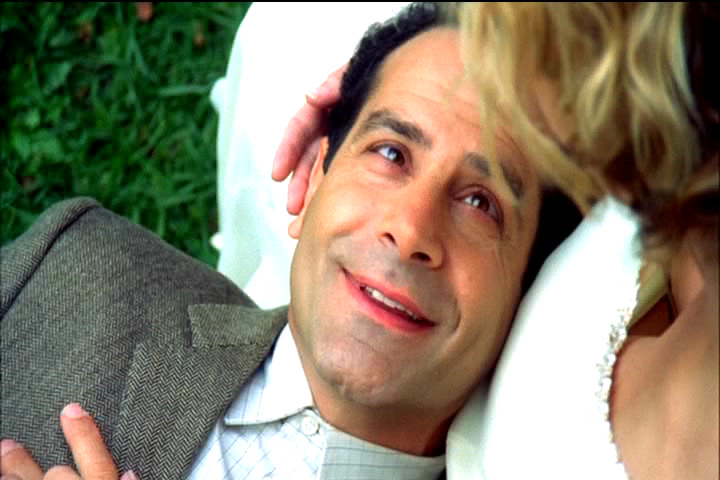
This subject that makes for one of the most sensitive and profoundly moving debates ever, I know, is not lost on everyone ... consider the TV show Monk about a brilliant detective who would not, could not, forget his wife after her deathher cherished memory is ever present with him.
Monk&Trudy.jpg

The beauty of Austen is how she captures both sides of any given debate with such clarity so that both sides are expressed equally well. This brings up the question, did someone with such a gift for seeing the different sides of an issue have trouble making up her own mind because she could see both sides of things so well it made it impossible to decide? Could this be why she never married?

“He is handsome, but will he remain so after he gains twenty pounds and becomes less active? Of course, he may become more active and always be away from home if he finds me disagreeable. Or perhaps I will find him disagreeable and yet he wants to always be with me ... handsome or not, disagreeable would quickly become tiresome. He has a strong youthful face now, but these British men have a tendency to wrinkle early ... could I manage to look at a badly wrinkled face each night before I am off to bedwhat horrors might await me in my dreams? And another thing, he might be a great reader but despise my writingthat of all things would be too much to bear, to see him comfortably seated enjoying some other person’s book while my stories remain only in my head ... yes, come to think of it, there are far worse things than not being married.”


Yes, we are so glad she wrote her stories, they were published, and today we can enjoy her great debates.

Wednesday

We're on Facebook!

Finally ...

I never liked Facebook way back when, so I stayed away from it. But things change and I recently thought it would be a good idea for us to get an FB page for our writing.

It's taking me just a little while to get to know it, but I find it's pretty much like Instagram and even Google+ in the way it's all set up. Not sure which I like best, but I do like that on IG you can find more people or interests easier through hastags. Maybe I just haven't experimented enough on FB yet.

So, we're looking for more followers or likes to get that page going! We have a standing offer of our eshort story "The Conversation ..." free for those that like our page. I'll probably take that down after a certain period of time, so catch it while you can!

Here we are: www.facebook.com/AuthorsNoeandCindy


Thank you for reading what noeandcindy.write !
This post is by CINDY

Friday

Goodreads review: Ann Veronica

Noe's review


Ann Veronica, a modern love storyAnn Veronica, a modern love story by H.G. Wells
My rating: 2 of 5 stars 

H. G. Wells - that name makes most of us think of science fiction, so when I came across a love story by him, I had to read it. Not because I’m a big Wells fan, though. I have read the Time Machine and War of the Worlds and didn’t like either one. The movies based on those two stories are much better, but still the idea of a science fiction guy writing romance was intriguing.

To be sure, he has a real knack for writing sweet words. I would say some of his expressions are downright beautiful. However, he had a tendency of having his words of romantic sentiment go toward the idea of religious devotion (meaning the men would say things like Ann was deserving of worship, etc) and for me that was distasteful.

As far as the story goes, it started out good. Twenty-one year old Ann Veronica began as an interesting character, a woman struggling with submission to her father or making her own decisions about her life. Wells makes a couple of references to Jane Austen in the context of whether Ann should be like a JA heroine or should she be a modern woman, which is the idea behind the title. I think if he wanted his book to be a counter to JA’s books, though, he should have written a better story. I mean, seriously, don’t mention one of the greatest romance writers of all time in that light without delivering something brilliant!

Unlike Austen he gives no real good reason why Ann Veronica falls in love with the person she ends up with, which is a big deal because the guy is married but separated from his wife. The truth is, all the men in the book are pretty lousy. Granted, one is more lousy than the others, so at best, her options are poor. Elizabeth Bennet would have stayed single with the options he gives in this book. Jane Austen understood, one key ingredient of a great love story is a great guy worth falling in love with.

The character Ann never grows more interesting, she just becomes a girl that makes choices that were hard for this reader to get behind. He created some interesting situations for her, but fails to make them interesting. It was a real challenge to finish the book; usually I don’t bother to finish one that loses my interest like this one did, but I was hoping he would get back to the feel and rhythm of how the book started, yet it never did.
~~~~~

Note: Goodreads rating is as follows:
 did not like it
 it was okay
 liked it
 really liked it
 it was amazing
~~~~~
Amazon Customer Reviews Guidelines 
Frequently Asked Questions from Authors
2. Are authors allowed to review other authors’ books?
Yes. Authors are welcome to submit Customer Reviews, unless the reviewing author has a personal relationship with the author of the book being reviewed, or was involved in the book’s creation process (i.e. as a co-author, editor, illustrator, etc.). If so, that author isn't eligible to write a Customer Review for that book. Please review our Customer Review Guidelines for more information. 

And this About Customer Reviews policy:
Authors and artists can add a unique perspective and we very much welcome their customer reviews[Underlining ours] While we encourage reviewers to share their enthusiasm and experience, there can be a fine line between that and the use of customer reviews as product promotion. We don't allow anyone to write customer reviews as a form of promotion and if we find evidence that a customer was paid for a review, we'll remove it. If you have a direct or indirect financial interest in a product, or perceived to have a close personal relationship with its author or artist, we'll likely remove your review. We don't allow authors to submit customer reviews on their own books even when they disclose their identity[Underlining and italics ours]

Monday

Comparing Jane Eyre and Elizabeth Bennet

Who makes the most compelling heroine***?

This is not about which is the better story, but rather which of these girls is most to be admired for their character and outstanding achievements.


Let’s begin with Elizabeth Bennet, who is admired for standing up for her ideal of love even when doing so puts her at a decided disadvantage by turning down the marriage proposals of Mr. Collins and Mr. Darcy. She is applauded for not compromising on this most personal of matters having to do with love and marriage. In view of the time and culture that she lived in, as well as having the constant urging of her mother, her example makes us hope we would do the same for love today. Like the song What I did for Love says: ‘I won’t regret what I did for love.’

As brave as Elizabeth’s actions were, there was also a certain safety in the course she chose. Consider: she had a family that loved her, her best friend was her older sister, and her father cherished her company. Mr. Bennet was not nearing death, so the consequence of not marrying right away was still some time off in the future. Yes, young ladies did routinely marry younger than she was at that time, but her friend Charlotte, who was seven years older than Lizzy, was still unmarried, and seven years for a twenty-year-old is still a long time—the possibilities and prospects associated with the youthful mind can be endless. So, that begs the question, was she being more safe than brave in the course she took? Was she really a hero ... a person of distinguished courage, admired for brave deeds and noble qualities?


Turning to Jane Eyre, she is but ten years old when we are introduced to her, being raised, as we all know, in a home where she is despised and treated cruelly. And yet, at this tender age she stands up for herself to her aunt and embraces the challenge of a new life in a school far away from the place she has called home. Meet the unexpected with head held high—a real hero. When things improve for her at the school, she grows up to be a teacher. At eighteen years old now, instead of opting for the security of what she has, she bravely and courageously sets out to see what lies beyond the walls of her present comfortable situation. Once again, we see the character of a hero. As the story goes, we keep seeing Jane Eyre’s resolve to do the brave thing, the right thing—even dividing her inheritance at the end with her new found family. All this is the mark of a truly compelling heroine.

Therefore, in answer to the question Who makes the most compelling heroine, Elizabeth Bennet or Jane Eyre?, I would have to say: in the case of Elizabeth Bennet, we have a girl that is brave by her inaction, which can also be seen as playing it safe. Assuredly, she is a compelling female character in a love story, but not really a heroine in the true sense of the word. On the other hand, Jane Eyre’s courage and bravery are marked around every turn by her displaying herself as a woman of action even as she marches into the unknown. She is a true hero.***

~~~~~~~~~~

Notes:
Here's the song What I Did For Love:
Josh Groban official video on YouTube
Josh Groban lyrics from AZ Lyrics
Here's a similarly titled song, but not the one I was referring to:
Stephen Cornwell singing another version on YouTube
lyrics on that David Guetta version from AZ Lyrics

***The article, The End of Heroines, from The Book Rat blog has a very interesting take on the use of the words hero and heroine. I wrote this before coming across that article and was already using the words interchangeably, but it's definitely food for thought!

Wednesday

Goodreads review: Jane Eyre

Noe's review

Jane EyreJane Eyre by Charlotte Brontë
My rating: 4 of 5 stars 

Jane Eyre is an excellent story with great characters and is told by a master of the art. Each person that is introduced is brought out in marvelous clarity; even the minor characters in the book are seen as distinct individuals, not just impersonal voices who appear to say a line and then exit stage. Charlotte Bronte’s ability to express feelings and mood often approaches what would best be described as poetry. In addition to this, the conversations are unbelievably terrific. So often a writer excels at one and does the other poorly, but not Charlotte Bronte—she does both with skill and beauty.

Jane Eyre isn’t without fault as far as I’m concerned, though. Three aspects, in particular, keep it from being so:

  • First, there were several places where Bronte went on too long about things that were of no importance to the story and of little interest. I subscribe to the principle: you have a story to tell, tell it without taking long detours. If it was a modern novel, I would say she was concerned about a certain word count, but perhaps they were in her days also, which would explain it. Whatever the reason, there is much that could be cut out with good effect.
  • Second, I wish she would have refrained from addressing the reader. I don’t like that because it dispels the feeling or mood that a scene is creating by reminding me that I am just reading a book. How much sense does it make for a writer to work diligently to pull us into their imaginary world just to snap us out by saying something like ‘dear reader...’ I only want to be reminded that I’m just reading a book when it’s time to stop reading, not while I’m caught up in it. This might best be put under a pet peeve, whereas the other two issues I stand firm about.
  • Third, the conclusion. By that, I mean the very last few paragraphs of the book. Bronte spent them talking about and quoting St. John (the character in the book, not the Bible writer), of all people. It was almost like she felt some pang of conscience about writing what is essentially a secular story and was compelled to end with a religious message and scriptural references. I don’t mind Bible quotes and things like that, but St. John was such an unlikeable character and was of little consequence to the overall story, why have him be the last person we hear about? What mattered most to me when I got to the end was how things turned out for Jane, the person who had gone through so many trials and challenges.

Those three things aside, I will reiterate, this is a wonderful book—indeed, a masterpiece. Anyone who thinks of it just in terms of a romance novel is basing their opinion on some movie adaptation and not the book. Not that I think romance novels can’t be great; Jane Austen puts the lie to that notion. But to distill Jane Eyre to just a story about a man and woman falling in love is as ridiculous as relegating it to simply a story written for young girls to read. It is epic in its scope of covering the range of human emotions and doing so in a way that a person would have to be made of marble not to be touched. The book masterfully takes us through the depths of despair and the heights of great joys and even the everyday coping with life with the flare that only a genius can. So glad I got a better copy and was able to read the real story.

Note: Goodreads rating is as follows:
 did not like it
 it was okay
 liked it
 really liked it
 it was amazing
~~~~~
Amazon Customer Reviews Guidelines 
Frequently Asked Questions from Authors
2. Are authors allowed to review other authors’ books?
Yes. Authors are welcome to submit Customer Reviews, unless the reviewing author has a personal relationship with the author of the book being reviewed, or was involved in the book’s creation process (i.e. as a co-author, editor, illustrator, etc.). If so, that author isn't eligible to write a Customer Review for that book. Please review our Customer Review Guidelines for more information. 

And this About Customer Reviews policy:
Authors and artists can add a unique perspective and we very much welcome their customer reviews[Underlining ours] While we encourage reviewers to share their enthusiasm and experience, there can be a fine line between that and the use of customer reviews as product promotion. We don't allow anyone to write customer reviews as a form of promotion and if we find evidence that a customer was paid for a review, we'll remove it. If you have a direct or indirect financial interest in a product, or perceived to have a close personal relationship with its author or artist, we'll likely remove your review. We don't allow authors to submit customer reviews on their own books even when they disclose their identity[Underlining and italics ours]