Showing posts with label Jane Austen books. Show all posts

Friday

Picture quotes

Playing with photos ...


Reading is fun, if you enjoy it.
Taking pictures is fun, if they come out any good.
Finding cool quotes to go with your pictures is super fun!


Groucho Marx quote. Hammer the dog.
Noe and Cindy write

Jane Austen quotes
Noe and Cindy write

Louisa May Alcott quote, Eight Cousins
Noe and Cindy write

Jane Austen quote, Sense & Sensibility
Noe and Cindy write

Do you have a favorite? Quote ... or picture??

           Thank you for reading what noeandcindy.write !

              Join us: facebook.com/AuthorsNoeandCindy

Sunday

Coming soon ... our new novel!

We are excited to inform all lovers of Jane Austen fan fiction that we will very soon be releasing a new novel about Mary Bennet and Georgiana Darcy. This is a follow up to our first book, Mr. Darcy falls in love.

The story takes place more than a year after Darcy and Elizabeth are married and proceeds from the notion that Mary and Georgiana have developed a friendship based on their shared interest of playing the piano as well their similar feelings toward social gatherings.

We developed the characters based on what Pride and Prejudice tells us about the two girls, so you will find Mary and Georgiana recognizable except for what could reasonably be expected in the way of personal growth with the passage of time. 

This tale was born from Mary's unique personality among the Bennet sisters. In Pride and Prejudice, there is an inkling of Elizabeth Bennet's angst about the options available to women of the time; in our novel about Mary, we have been able to take that further and make it the driving force of the story. Even now, two hundred years later, women are still confronted with obstacles in their pursuits just because of being female. This makes the story resonate with today's modern women. 

Stay tuned for further posts on the new book, including its title.

Noe 

Thursday

"Pride and Prejudice" and "Mr Darcy falls in love" side by side

Noe and I have recently been reading our book, Mr Darcy falls in love, along with Pride and Prejudice just for the enjoyment of it. Of course, when writing it, we diligently referred to her incomparable book many times so as to write our story from Darcy's point of view with the same timeline and events.

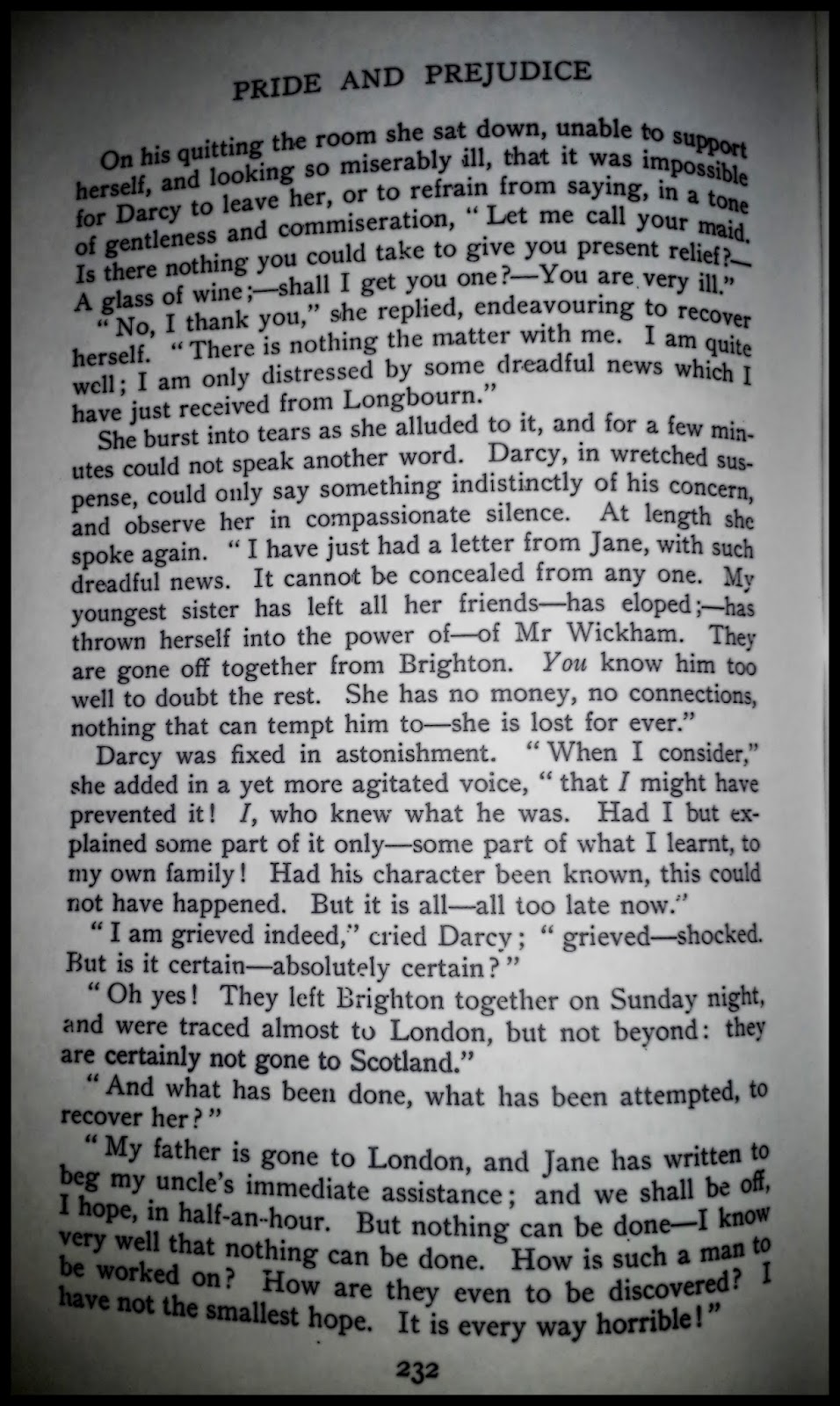
Here's a section I really enjoy, where the two stories are discussing the same episode, one through Lizzy's eyes and the other through Darcy's. I hope you enjoy it too!

Pride and Prejudice:


and now ... 
Mr Darcy falls in love:


♥ We would love to hear your comments ♥
Thank you for reading what noeandcindy.write !

Pride and Prejudice movies, part 5

The little known 1967 version

The Bible says “pride is before a crash”, and as proof of the truthfulness of this inspired saying, I submit myself. 
☺☺
I have proudly declared knowing about every English production of P&P, and lo and behold, here is one I never knew about! In my defense, though, there seems to be no way of seeing this entire movie. There are only bits of it on YouTube, and those are of very poor quality. Nevertheless, as we are writing about the various adaptations here on our blog, it would be remiss of me not to mention this one. (Sorry it is out of date order, but we just found it) From the segments I have seen, I can say they seem to go along by the book for awhile very nicely, and then all of sudden they change things drastically. To read more about this version, check Movies MSN.

And so, like Elizabeth, who fancied herself safe in her assertions about Mr. Darcy, only to have to take it all back when she realized she was wrong... well, here I am, having to do the same about my knowledge of English-speaking
P&P versions. With confidence I will quote any thought from the Bible, such as the one above**, as being absolutely true. And now as someone who loves to read - and I should say, watch - all things Jane Austen, I can also say Pride comes before Prejudice.


**Proverbs 16:1


Wednesday

Pride and Prejudice movies, part 4

Our last post on P&P movies was on the 1995 mini-series, thought of by many as the quintessential version. Both of us really like this set and have watched it many times. And as previously noted, Noe will be doing future posts that get into detail about characters and persons who played each part, as well as favorite scenes and that sort of thing.

But we recently found this interview from 2006 to be very entertaining. Some of the cast and crew members are looking back at the success of their movie, and give us insight into a lot of things about it. For instance, did you know the scene at the beginning, when the Bennets are coming home from church, was shot much later, after the cast had gotten to know each other a lot better? No wonder that's such a nice "family" scene -- they really had become like a family by then. It wasn't necessarily planned that way, but that's how it happened. I just love that kind of trivia.

Sadly, the whole cast was not in this; as a matter of fact, I'm still looking for interviews with Jennifer Ehle or Colin Firth about this movie. But this has Mr. Bennet (Benjamin Whitrow), Mrs. Bennet (Alison Steadman), Mary Bennet (Lucy Briers), Mr. Bingley (Crispin Bonham-Carter), Mr. Collins (David Bamber), and Mr. Wickham (Adrian Lukis) along with Sue Birtwistle (Producer) and Carl Davis (Composer).


I'm sure you'll enjoy it:

Thank you for reading what noeandcindy.write !

Pride and Prejudice movies, part 3

1995 BBC, A&E version

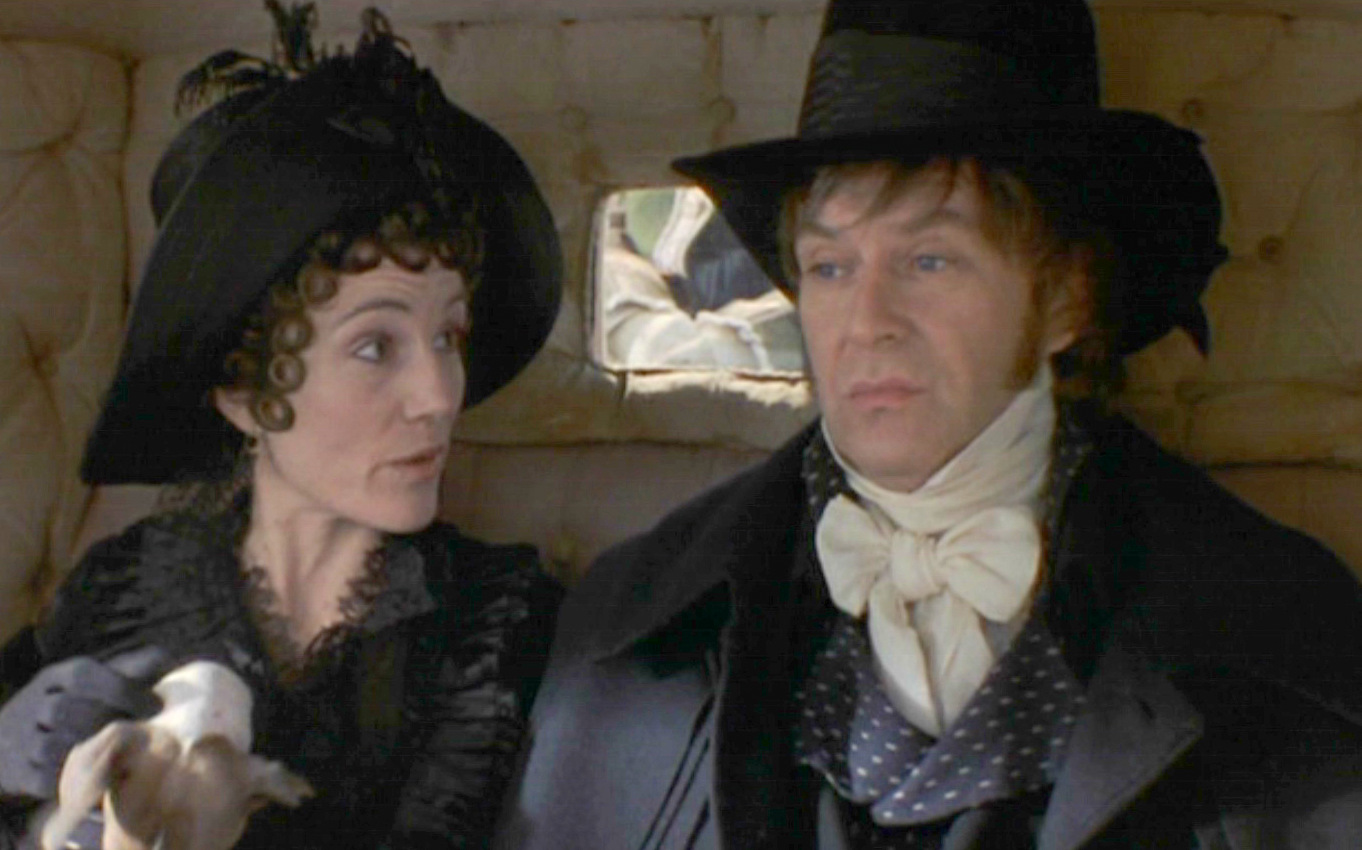
Mr. & Mrs. Bennet and their five daughters

This is actually a six-episode BBC production television drama which aired in 1995 in Britain and then aired on A&E Network as a mini-series in early 1996. Starring Colin Firth as Mr. Darcy and Jennifer Ehle as Elizabeth Bennet, this version is considered by many as the quintessential adaptation of Pride and Prejudice. For instance, when Masterpiece Classic was remaking Austen’s other works from 2007-2009 -- Emma, Sense and Sensibility, Persuasion, Northanger, and Mansfield Park -- they did not see fit to remake P&P, but chose simply to air this version.

To be sure, more was done in the production of it: instead of having sets as was done in the 1980 version, it was shot on location, and there are many beautiful country scenes and exquisite homes to see. This always lends a sense of class to any movie. The lighting and editing is also much better than its 1980 predecessor (and other things that I’m sure have names for them if you’re in the movie-making business, but for those of us who aren’t, we just say it looks a whole lot better).

For me, though, the more often I have seen this one, the more fault I find in it. In my opinion, this version doesn’t get good until Episode 4
, which takes up after Mr. Darcy has proposed to Elizabeth. When I get to particulars of characters and scenes on our future posts, I will be specific as to what I think should have been done differently.

That being said, it is nonetheless five hours of Pride and Prejudice, and that alone is reason enough to see it! If you are not smitten with the brilliance of Jane Austen, you may well consider that a reason not to watch it, in which case you’re not reading this post anyway.

But for the rest of us, even that short amount of time just isn’t enough . . . which is why we are glad there are other adaptations, and why we own all of them we can, so we are able to watch them again and again.

Links to PBS on the movies mentioned:
Emma
Mansfield Park
Sense & Sensibility
Northanger Abbey
Persuasion
Pride & Prejudice

Pride and Prejudice movies, part 2

1980 BBC Version (265 min)
2013 = 200 years of Pride & Prejudice

Listed on IMDb as a TV mini-series, this five-part version of Pride & Prejudice stars Elizabeth Garvie as Eliza Bennet and David Rintoul as Mr. Darcy. Our first impression of this version left something to be desired. It seems poetic, then, that upon closer examination it improved -- or more accurately said, the more often I have seen it, the more I have come to enjoy watching this one. 

You might wonder, though, why we would bother to see it again if we didn’t think so much of it the first time. Well, we all know about First Impressions! And Cindy and I have often found that seeing movies a second time has changed our initial impression, and that certainly happened for me with this version.

There are many things to separate this adaptation from the others, some being things that would recommend it, others would be up to the individual. First thing you notice is the look: it has the appearance of a live performance, except for the outside scenes (why there’s a difference, I don’t know, but it’s definitely noticeable). And the acting has that sense of a live theater production, that sort of tone and cadence associated with a play. So for those who like the idea of P&P done in that manner, this will be appealing; for others it might come across as cheaply done, although the sets and costumes are nice.

Here are some aspects of this version that separate it from the others and make it worth watching:

It has more scenes taken from Jane Austen’s book than any of the others. For example: the day after Lizzy was slighted by Darcy about only being tolerable and not handsome enough to dance with, all the girls, including Charlotte Lucas, are talking about it at the Bennet home, and it’s enjoyable to see that conversation. Another I like is when Charlotte asks Lizzy to play the piano, and Darcy hears her play and sing for the first time. There are many other such scenes that give viewers who have not read the book a more complete picture of this treasured novel.

Something else that is very charming is the interaction between all the Bennet sisters in various settings, which one would expect from a family of five girls not greatly separated in age. Things like having a mother whose sole purpose is to get all five girls married, and of course, their love of balls. This really highlights what living at that time in a close-knit family must have been like. And we should mention, all the actresses are cute, as all the Bennet girls are reputed to be.

Hence, if you haven’t seen this one, I recommend you give it a good look.


Let's talk about Pride and Prejudice movies

This being the 200 year anniversary of Jane Austen’s Pride and Prejudice, we will be joining in the conversations about this great book and some of the movies that have been made of it. We have scheduled a systematic approach, beginning with discussing the movies in general, one at a time. After that, the posts will take a look at the individual characters of the book, which actor played them, and our opinion of how good the portrayal was. We will also take a look at various scenes from the movies in comparison to how the scene is portrayed in the book.

We have chosen to start with the 1940 movie version, starring Greer Garson as Elizabeth and Laurence Olivier as Darcy. Now, when deciding to write about the movies, we determined not to rate them from best to worst. The reason for that is, we think there are major flaws in all of them, except this one! Yes, this version deviates wildly from the book, and there are probably only four scenes in the movie that are actually from the book... 
so maybe that is a flaw -- LOL

But what we love about this movie is that it actually captures the feel of the book better than the others do. Lizzy is funny and independent, the acting is strong from all the players, the costumes are wonderful, and most of all -- yes I know I’m repeating myself -- this movie has that light-hearted sense of humor that the book has.

P&P is certainly not written like a drama, even though it has the stuff of drama: broken hearts, ruined reputations, slander. But this is the genius of Jane Austen in her book, Pride and Prejudice. She sees the sense of humor in life’s episodes, and by means of Mr. Bennet’s sarcastic humor and Lizzy’s clever wit (not to mention Mrs. Bennet’s silliness), Ms. Austen keeps P&P from having the same dramatic feel as her books Persuasion or Sense and Sensibility.

I don’t think the term dramady quite fits it, because that word suggests more drama than comedy. I would suggest a whole new word: comed-ra, or for those who like bigger words, comdramady. Whatever it’s called, it is our opinion that this version is more true to the spirit of the book.

Cindy's note: Here’s a scene that not only shows a wild deviation from the book,
but at the same time captures the light-heartedness of this version. I wish I could have gotten the whole scene that comes before this part, but maybe you can watch the whole movie sometime. By the way, we did see the colorized version of this once, and it's really beautiful. Just never have been able to find it to buy.


Friday

200 years of Pride & Prejudice!

Two hundred years of Pride and Prejudice, and with all the blogging going on about it, this is one discussion we definitely want to be a part of!

I will begin by relating how I was introduced to this story. One night more than twenty years ago, I came home late from work.  Cindy and our son were asleep, but I was too wound up to go straight to bed, so I turned the TV on and started watching a movie. I didn’t even know the name of it, but recognized Greer Garson and Laurence Olivier. The movie immediately grabbed my full attention, because it was really funny! I came in around the middle of it - 
I say middle meaning somewhere after the beginning - and can point out the exact scene:  it’s the part with the bulldog puppies.

Anyway, I finally found out the name of the movie on one of the commercial breaks -- Pride & Prejudice. At the time, I had no idea there was a book by that name, and with head held low, I must admit I had never even heard of Jane Austen. But I loved this movie and had to go rent it asap so I could see the whole thing and share it with Cindy, after which I quickly bought it. It was VHS; there were no DVDs back then... as a matter of fact, we had just recently purchased our first VCR and entered the world of watching what-you-like when-you-like at home!

This was my introduction to one of the greatest love stories ever told.

Although it has been many years now, I have made it a practice to read P&P once a year. Each time the dialogue sounds fresh, and of course, funny. Even though I know the story so well, I find myself swept along, feeling all the emotion I did the first time I read it. Despite the fact that some guys would laugh at that, I think most who kid their wives about “chic-flicks” really enjoy them as much as the women in their lives do. I mean, there are plenty of “real men” involved in the making of these films.

For the two hundred year anniversary of P&P, we will be blogging about the movies, characters and so on. We look forward to sharing our thoughts about what we like and don’t like about the different movie versions -- there are many, you know. And we will consider each character and who we think plays the part best.

Even though we take our Jane Austen quite seriously around here, it should be great fun. Please join us and leave comments whenever you feel like it.


Monday

More on Jane Austen's heroines... post six

Jane Austen's master touch in creating a female character, putting her in the perfect situation to bring out that which defines her, serves as one of the main ingredients by which the tension of the story builds. Today let’s consider her book …

MANSFIELD PARK
I might get slapped for this, but I say Mansfield Park is the only story where there is a true rivalry for the affections of the same person, Edward Bertram.

The two women in question are Fanny Price and Mary Crawford. Fanny is Edward’s cousin, and her family is very poor; whereas Edward’s family is very rich and live in Mansfield Park. Fanny is permitted to live with the Bertrams out of kindness.

Mary Crawford is a wealthy, sophisticated lady, the kind of lady that is antagonistic with the object of her affection, having all the charm and looks so as to keep the guy coming back for more.

Fanny, coming from such poverty and being reminded by her cousins that she is not a Bertram but a poor Price, develops the strength of an honorable character. Her sense of gratitude turns out to be far more appealing, because of the genuineness of it, than all of Mary Crawford’s sophistication and practised man-baiting.

Noe 

Thursday

Heroines... post five on Jane Austen

CONTINUING OUR LOOK AT JANE AUSTEN'S HEROINES


Sense and Sensibility


This story had the title "Elinor and Marianne" to begin with, and that's quite appropriate, but the latter title is even more so. Here we have two heroines, the Dashwood sisters: Marianne, who is 17 years old, and Elinor, who is 19. Right from the start, the girls go from great wealth to having very little, because they have a rat — with a capital R — for a half-brother. Despite explicit instructions from his father on his deathbed, the man refuses to help in even the smallest way when he dies and, as so many rules of inheritance back then play out, everything goes to the Rat.
The RAT brother
Happily, a relative of their mother saves them from poverty and offers a small cottage for the bereaved family to live in. Ere long, Marianne has Colonel Brandon showing a clear interest in her. However, she is uninterested because he is twenty years older! — which is actually refreshing, considering in those days old guys are always marrying teenagers and no one seems to bat an eyelash! Anyway, Marianne is filled with vitality both physically and emotionally and she figures an older man just won't do ... enter Willoughby, a dashing
young man who is handsome, loves the same poetry as Marianne, and (to top it off) will inherit plenty from his aunt. Just as things seem to be turning up roses for Marianne, Willoughby abruptly leaves, with no hope of returning. This turns Marianne into one of the most lovelorn figures in Austen’s world.

Then there is Elinor, who is prudent and rational — and it is a good thing, too! Her situation becomes complicated: she develops feelings for one Edward Ferrars, only to learn from Lucy Steele that he is secretly engaged to ... Lucy Steele! I know this makes Edward sound like a scoundrel, but he really isn’t, and Elinor knows that. Now, with Marianne torn up over Willoughby, and a mother that acts more like a younger sister than a mother, Elinor must bear her emotional turmoil with patience and a deep regard for doing what is right.
With Marianne’s emotional openness playing off Elinor’s silent endurance, what is created is a gripping emotional drama that makes you yearn for something good to happen to the Dashwood girls. Once again, Jane Austen has created an intriguing story with strong female main characters.


Noe 

Heroines... post four on Jane Austen

Heroines, beginning with Northanger Abbey

Jane Austen has the touch of a master in creating a main character and then putting her in a perfect situation, one that brings out the characteristics which define the heroine. With that, the main ingredients are set by which the tension of the story builds. For instance, today let’s briefly consider her book Northanger Abbey.

The heroine of this story is Catherine Morland, a naive country girl who is taken out into society for the first time by her family's childless neighbors, Mr. and Mrs. Allen. In Bath — which is actually a place in England, despite how it might sound — she meets Henry Tilney. This fine, witty young man comes from a wealthy family, and he is immediately captivated by Miss Morland's innocence and simple country manners. Henry’s father, who is more interested in money and position, is informed by someone that Catherine is to inherit a great fortune from Mr. Allen, but this is simply false.

As a true genius, Austen has made young Catherine an avid reader of Gothic stories, and this admits a closer look at her inexperience and simple-mindedness, not to mention creates a fertile ground for her wild imagination. When she is taken to the Tilney's home, Northanger
Abbey, which is an old monastery being done over in as modern a fashion as that time period would permit, the outward appearance and interior design is enough for Catherine to be carried away under the influence of her Gothic stories!

What will Miss Austen do now? Will love bloom between Henry and Catherine? ... or is to be strangled in the dark halls of
Northanger Abbey? With each time I read this tale, I grow more fond of the young heroine Catherine Morland and am sure you will too.
Noe